
Integrating 'Whitewashed Hope'
How might the principles and ethics of permaculture, Buddhism and Taoism help integrate the message of 'Whitewashed Hope' into practice?
I was recently introduced to Whitewashed Hope, a message written by Indigenous leaders and organisations, shared a few years ago in various corners of the internet. I wrote my initial response to reading the piece, which you can find in the link below.

Upon my first and second reading of it, I was stunned by the points raised. It wasn’t that the grief, anger and frustration surprised me; I can’t fully understand what it must be like to have been colonised, abused and torn apart as a culture by ignorant invaders with totally different ways of being, all within living memory in some instances, nor to stand still now in your inheritance, pushing back as best you can against global consumerism and all it entails.
What took me aback was the offensive approach and simmering resentment towards groups and methodologies that are trying their hardest to work with our Earth, giving back rather than just taking. On reflection, it also surprises me how generic the statements about Indigenous ways of life seem to be in Whitewashed Hope, when the crux of the matter is each region, each ecosystem and each cultural group is so diverse and responsive to the place in which it grows. Generalisations must not be made about Indigenous groups, surely, as much as about permaculturists and the regenerative farms addressed by the piece.
But enough of that. I don’t know what initiated the dissemination of Whitewashed Hope, nor have I found many responses besides that of the Permaculture Association here.
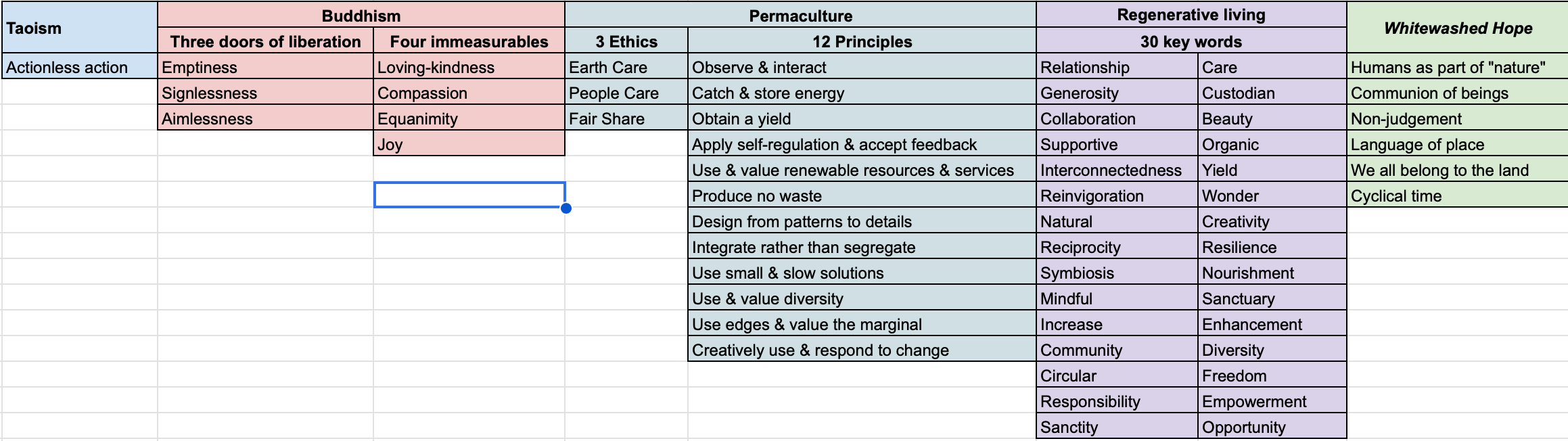
What feels most crucial to me now is how to acknowledge the points made by the Indigenous peoples represented, how to hold gratitude for the wisdom underpinning the message, and how to relate the points to the key ethics, principles and practices to which I adhere currently - namely permaculture, regenerative living, Buddhism and Taoism.
My hope from this is that it may bring me yet another step closer to finding a semblance of indigeneity of my own, grounded here in the British Isles, and may help others out there seeking to connect deeply with the land on which they reside - be that as indigenous or colonial descendant.

Taoism: the art of actionless action
I present wu wei, or “actionless action”, as the simplest and most profoundly impactful of the principles to which I subscribe.
Sitting at the heart of Taoist belief, actionless action calls each of us to let go of ego and pride, be who we are called to be, and avoid imposing our ideas and practices onto our planet and our neighbours.
I can think of no better place to start. However, wherever and whenever we may encounter indigenous peoples and their ways of life, we must begin from a place of respect, with an open mind and an open heart.
Just imagine how different our world might be now if people of the past had moved about with a sense of openness and eagerness to learn, unfettered by their prejudices, demands on and expectations of the world, and instead had adapted and shared and showed true gratitude?
We can now choose to move forward in the spirit of actionless action, letting what exists indigenously remain and thrive, recognising the value and experience therein.

Four Immeasurables, Three Ethics
I incorporate mindfulness of the Four Immeasurables - loving-kindness, compassion, equanimity, joy - into my every sitting meditation. I breathe each in on an inhalation, and visualise sharing each with the world on my exhalations. As I go about my day, this helps me remember to give them to myself and to give them freely to others around me.
Wherever we are in the world, the Four Immeasurables can be shown to all with whom we deal, whether indigenous or colonial, human or more-than-human.
Loving-kindness: Want what is best for those we meet, recognising that this is not what we believe to be best. We all have different backgrounds, methods, beliefs and goals. Loving-kindness is making space for these.
Compassion: See the world from others’ points-of-view and work to understand why they feel the way they do. The coming-together and writing of Whitewashed Hope clearly came from a place of anguish and frustration, which it isn’t easy for us in W.E.I.R.D.1 countries to empathise with. It’s important to try.
Equanimity: Try not to impose our own interpretations and truths onto what others do, say and write - which is easier said than done! Equanimity falls very comfortably into place with the non-judgement, non-binary statement of Whitewashed Hope.
Joy: Allow yourself to be joyous and facilitate the happiness of others. Supporting Indigenous peoples in being on their land, practising their customs and sharing their knowledge is essential to spreading joy amongst them, us and the wider world.
The Four Immeasurables weave between the Three Ethics found in permaculture: Earth Care, People Care and Fair Share:
Permaculture works to protect and regenerate our wondrous Earth, seeing all elements from a point of understanding their needs, their pain and challenges, and their unique importance.
Such understanding extends to humans too, whatever their self-reference (and I recognise here that maybe the permaculture ethics jar somewhat with Indigenous views, by separating “Earth” and other beings from “people”).
Fair share encourages and ensures we take what we need and not always what we might want - combatting exploitation, hoarding and inequality.
A fourth ethic, “Future Care”, has emerged in recent years. It’s not one I use much myself, because to my mind it’s intrinsic to and resultant from the three older ethics. The future will be taken care of if we adhere to caring for our planet and all its elements and facilitate every element receiving what it needs to flourish.

Twelve principles, six points
The most commonly used principles within permaculture are the 12 laid out by David Holmgren. While many other sets of principles exist, I’ll follow these for the most succinct, well-known of them.
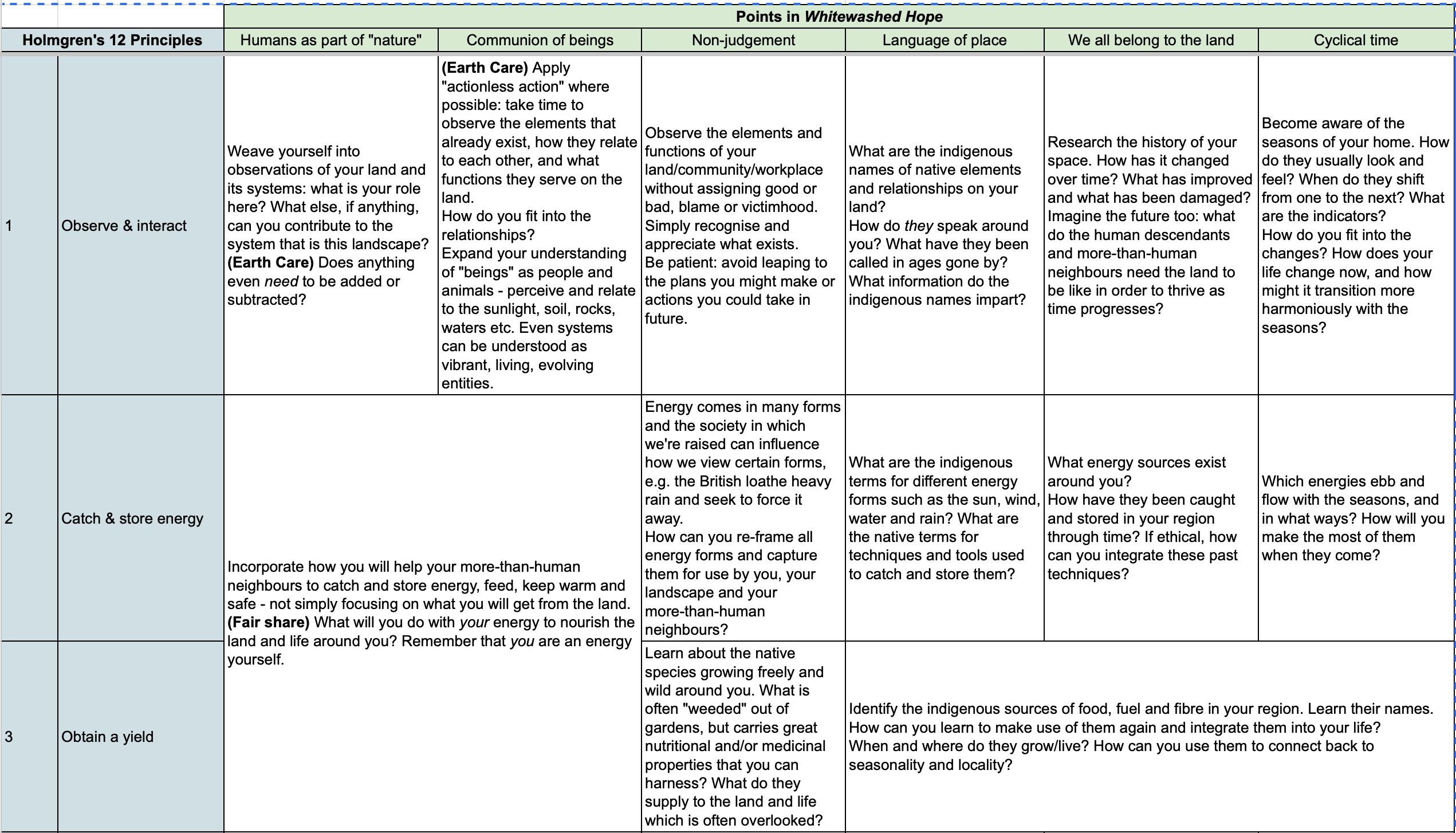
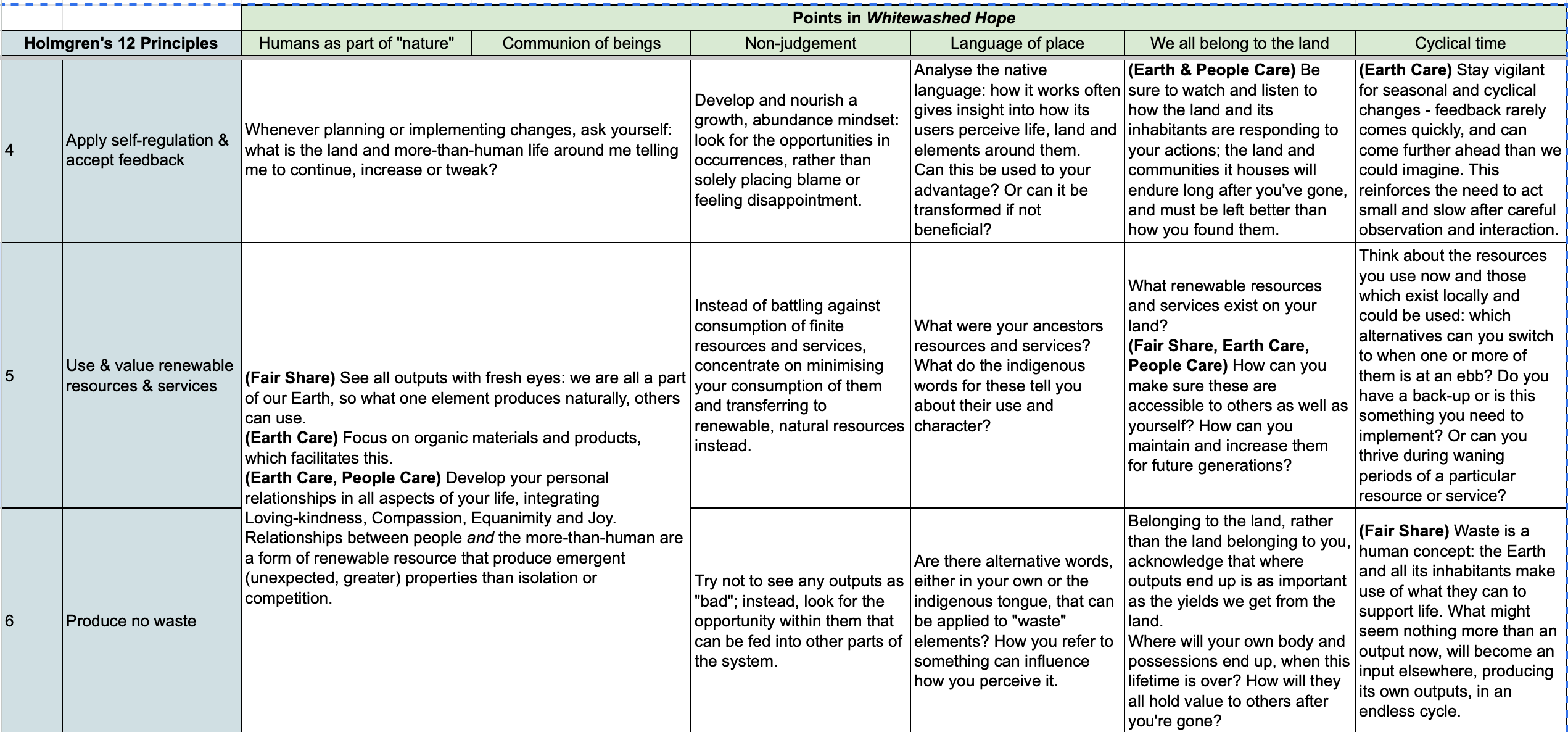
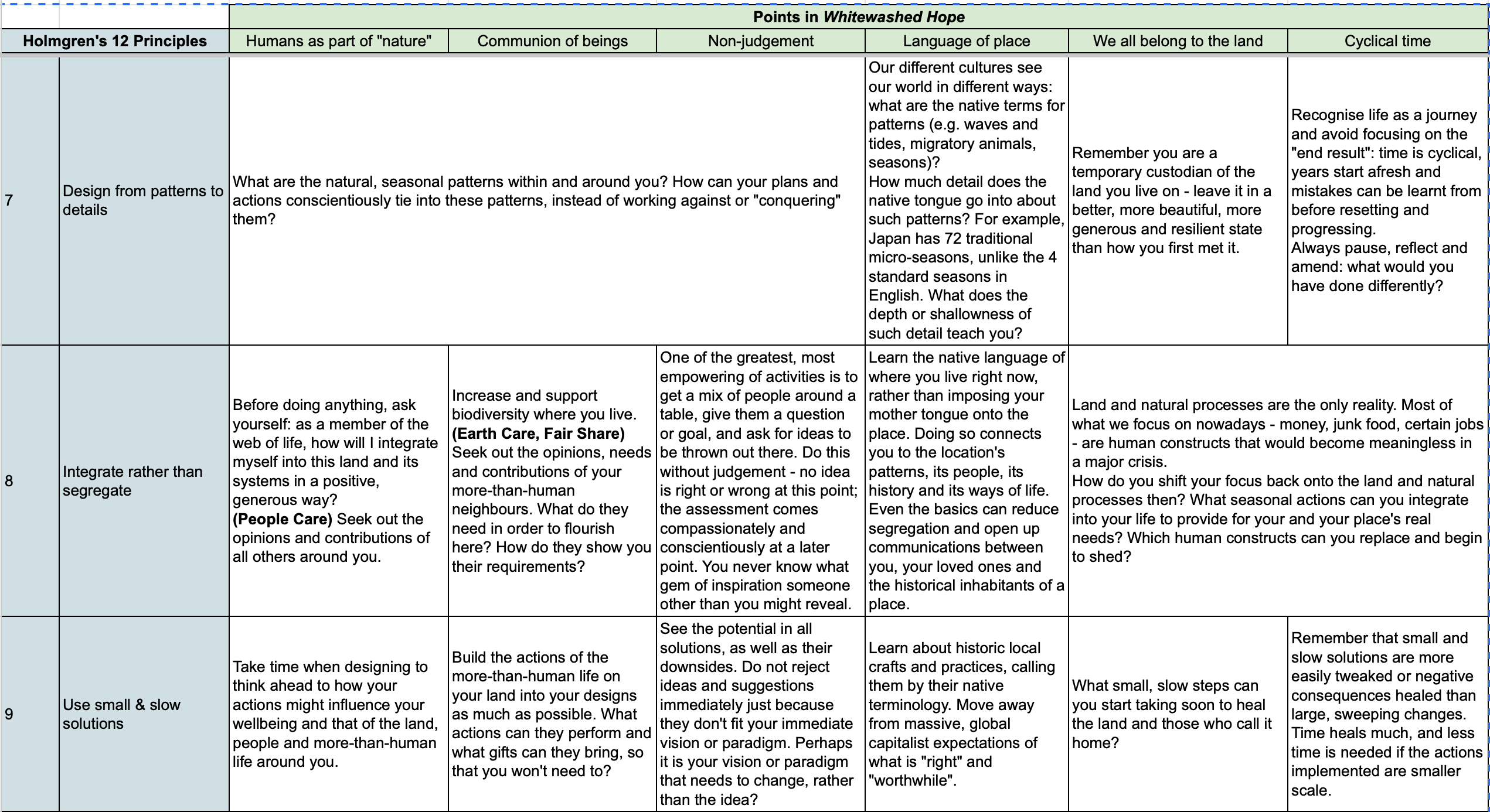
I weave these 12 principles into the six points highlighted in Whitewashed Hope, to guide my integration of the two perspectives into one more cohesive whole. The six points, to summarise how I understood them, are:
Humans as part of “nature”: There is no “nature” outside of humans, from which we are separate. All things are interconnected and interdependent. We humans are as much a part of natural systems as anything.
Communion of beings: This may be more recognisable to others as “animism”, although I dislike the outdated Victorian overtones of such a term. In essence, Indigenous thinking tends to recognise all elements as alive and integral to systems, whether animal, vegetable, mineral etc.
Non-judgement: Indigenous groups tend more towards openness and non-duality than modern “mainstream” society. Nothing is inherently “good” or “bad”, but rather brings something unique to each situation.
Language of place: Each region influences the humans living there and the cultures that emerge. The indigenous language is one of the most evident ways this occurs. The oft-repeated example of this is the multiple words for “snow” in Inuit speech, because snow is such an irrevocable part of life for the Inuit.
We all belong to the land: Land never belongs to people, even though boundaries and contracts might convince us otherwise. We are only ever temporary stewards of a space. The truth of people belonging to land and not land belonging to people is actually even more supportive of the need to allow Indigenous groups to access and tend the native space.
Cyclical time: Many of us nowadays see time as linear, and in some ways it is; but much of time is cyclical too. Many ancient and Indigenous cultures have understood this, and acknowledge that bad periods follow good, and good will come round after bad. How we respond to these challenges and opportunities is key, and we all have a part to play in such responses.

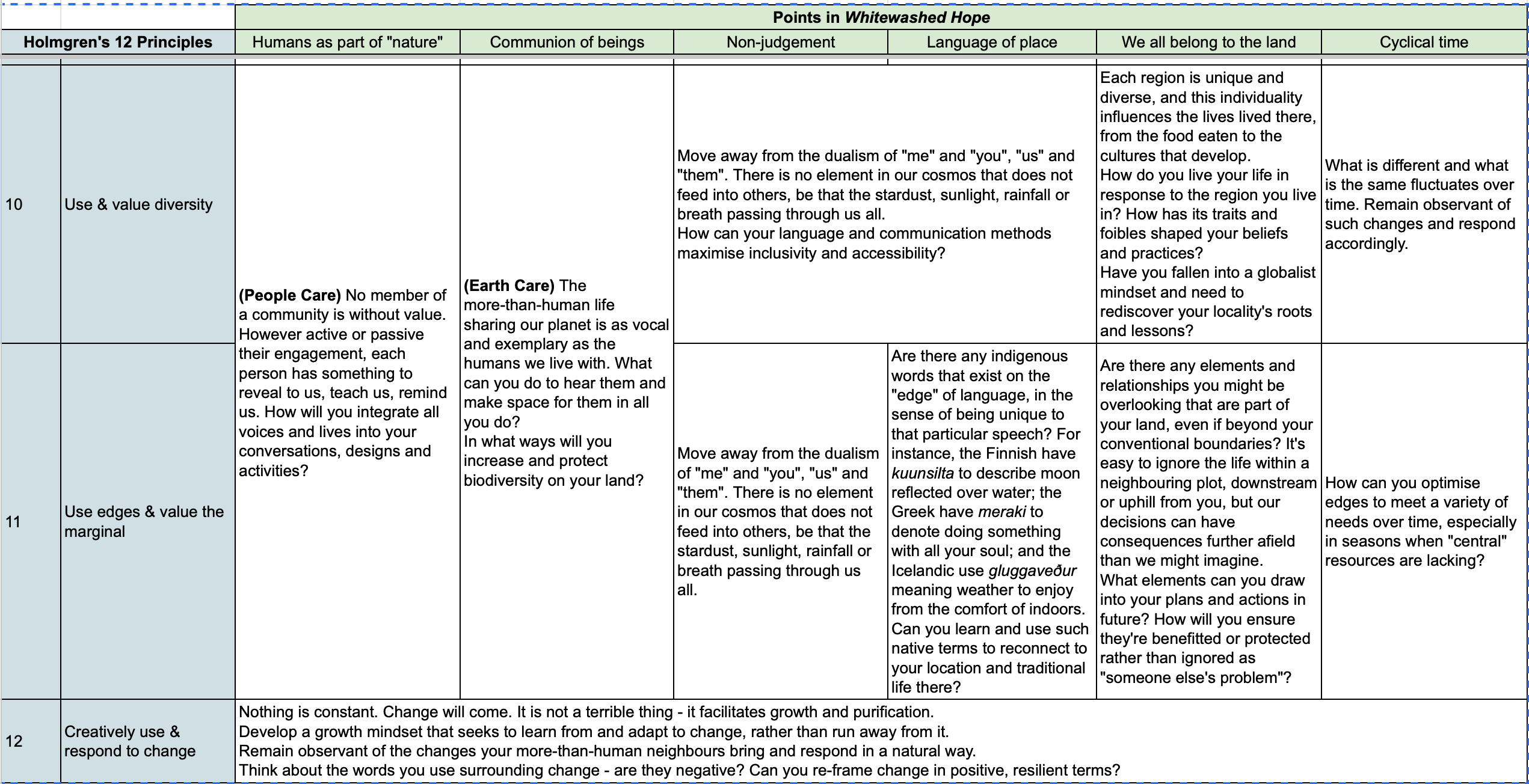
‘Communion of beings’
There are two terms in Whitewashed Hope which really sang to my soul. The first is defining ourselves as “weavers”. We don’t create or destroy life, but we do hold the power as humans to weave threads closer together - or to pick them apart, detrimentally.
And what are we able to weave together? All life, human and the more-than-human, because we are all part of a “communion of beings”, as Whitewashed Hope’s contributors call it.
The questions and points I’ve included in the table above seeks to weave together the indigenous values laid out in Whitewashed Hope and the Holmgren principles of permaculture, to integrate our Earth-focused, life-affirming visions and practices.
I understand this doesn’t go far on its own in bringing evicted Indigenous groups back to the land that shapes their souls, nor towards giving them back sovereignty over their beliefs, education, ways of life and wise land management.
I do hope, however, that it might strike a chord with those interested in and embodying permaculture, so that Indigenous values can be recognised, recalled and woven into those of permaculture.
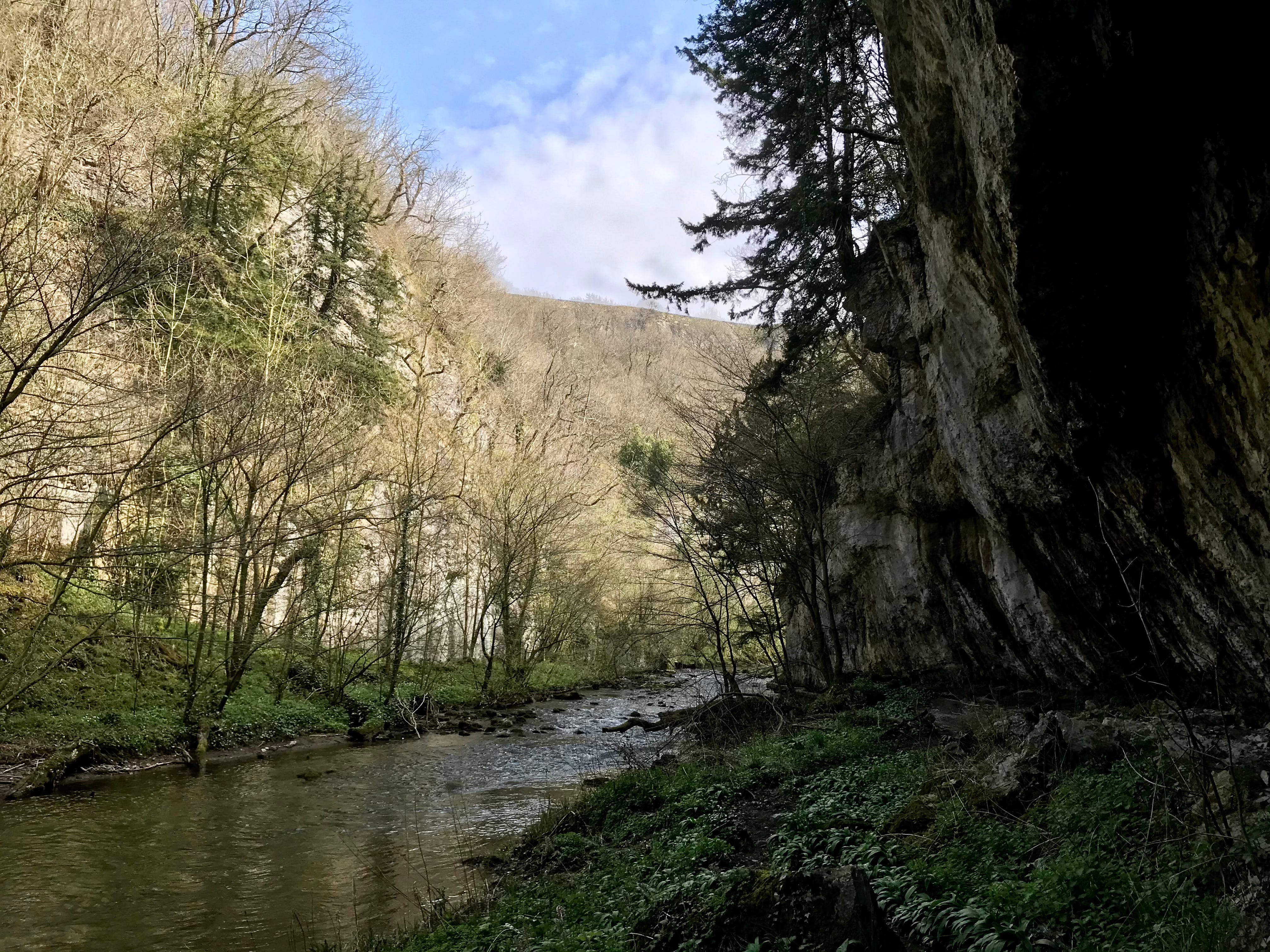
In a diverse world, what we have in common must be the starting point and the guiding light in healing schisms. To speak of “us” and “them”, “Indigenous” and “colonisers”, “our beliefs” and “your beliefs” is to widen rifts we must all work to close. This is not to make us all identical and lacking in nuance; it is to make the beauty of differences shine out even brighter, and give them a space to thrive, evolve and be witnessed.
Western - Educated - Industrialised - Rich - Democratic
You are doing a lot of interesting connection work here, and it feels like you are, like me, shaping a coherent philosophy through exactly that process of weaving.
What I find most resonant is the cyclical time section, because it sits close to my take on perennialism: the idea that deep patterns recur, that wisdom is not invented but re-found, and that rootedness in place is what makes continuity possible at all. What no one owns is the copyrights to those patterns. What people do own, or should, are the practices that hold it in a particular place.
I read "Whitewashed Hope" and I do feel it somehow is partly addressed to people like us: well-intentioned, framework-building, finding resonance. But I don't think there is a clean answer to that. It is not a simple topic at all, and naming it is probably the more honest thing. So I do believe your reflections on this are valuable.